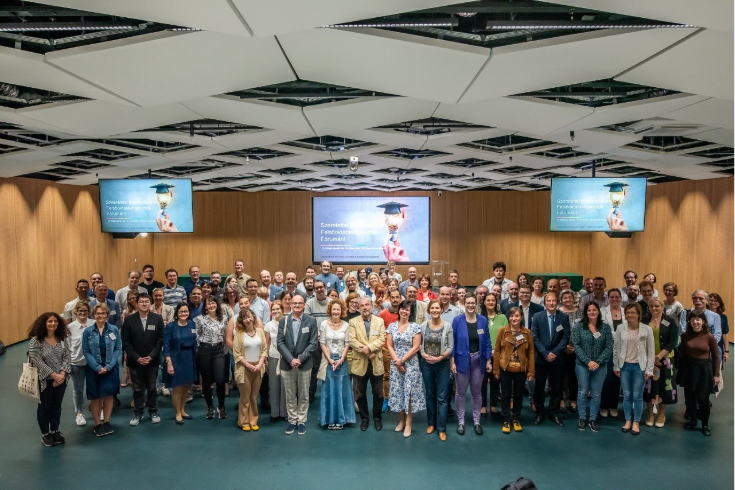
On May 24, the Hungarian higher education development community, which has been operating as a formal network since this year, held its first official meeting at the Gellért Campus in the form of an unconventional non-conference. Among other things, the event also featured the inaugural meeting of the Hungarian Rectors' Conference (HRC) new working group on higher education development. Its vice-chair is Kata Dósa, head of OMMK.
Network of centers for quality higher education
In the 1970s, the United States first expressed the need for centers engaged in educational development at higher education institutions to form a network in order to share and jointly develop the best teaching methodologies and to promote educational innovation.
In recent decades, professional networks with similar functions have been established in many countries, including Australia, the Middle East and Far East (e.g., Palestine, Taiwan, and Japan), various parts of Europe (the United Kingdom, Croatia, Germany, Sweden, Switzerland, etc.), Canada, New Zealand, and even in certain regions of Africa (e.g., South Africa and Egypt).
2020, the start of Hungarian networking
The initiative to establish a community of educational developers in Hungarian higher education was launched in 2020 by Károli Gáspár University of the Reformed Church, which was soon joined by the Budapest University of Economics and Corvinus University of Budapest. The goal of the three founders was nothing less than to establish cross-institutional connections and cooperation that would provide a platform for discussing common problems, disseminating and exchanging good educational practices, and channelling the Hungarian higher education development community into the international circulation.
A milestone in the development of higher education in Hungary
The informal network, which has grown steadily in recent years, reached an important turning point in 2024. From now on, it will continue to operate as a formal organization, as a working group of the HRC Higher Education Methodology and Educational Informatics Forum . This change guarantees the long-term survival of the community and may strengthen existing cooperation even further. For this reason, the working group's inaugural meeting was held at this year's first face-to-face meeting, the Higher Education Developers Forum at Corvinus University, where 28 institutional representatives determined the organizational foundations and operating conditions.
Íme a szöveg angol fordítása, az eredeti HTML kódokkal a megfelelő helyen: "The formalized operation also opens the way for new opportunities: in addition to greater international visibility, the Hungarian higher education sector can now join international organizations such as ICED – International Consortium for Educational Development, which currently connects a total of 27 national higher education development networks. For this reason, it is of paramount importance for our institution that Corvinus was not only a participant but also a leader in the establishment of the Hungarian network—which includes almost every player in domestic higher education—and furthermore, the official launch of the HRC working group took place within the walls of our new campus. Negotiations regarding the affiliation with the global network are already underway."
We have overturned everything we previously thought about higher education conferences.
The event was attended not only by the colleagues delegated to the HRC working group but also by other staff members from the various institutions' educational development centers. This provided an opportunity to establish as many professional connections as possible within the community. This networking was further supported by innovative program elements not commonly used before, such as the 'We are in the Same Boat' small-group problem-focused discussions and the 'Take and Carry' workshop demonstration sessions. Furthermore, the conference addressed key topics such as opportunities for increasing organizational visibility and preventing professional burnout. Additionally, participants were able to explore the innovative spaces of our new educational venue through a guided campus tour.
Who are the higher education developers?
These are professionals who are well versed in education as a profession and a science, and whose knowledge and experience enable them to understand its various segments. They intervene at the necessary points in university teaching with the appropriate expertise and in a spirit of partnership. Their work is based on scientific research, which they also use in the development of educational innovations.