
About Us

The Hungarian Rectors' Conference Higher Education Methodology and Educational Informatics Forum (HRC HEMEIF) was established in January 2024, coordinated by the KRE ICT Research Center. The aim of the Forum is to share experiences and best practices in the field of educational development and educational informatics, as well as to develop digital competencies in higher education. 
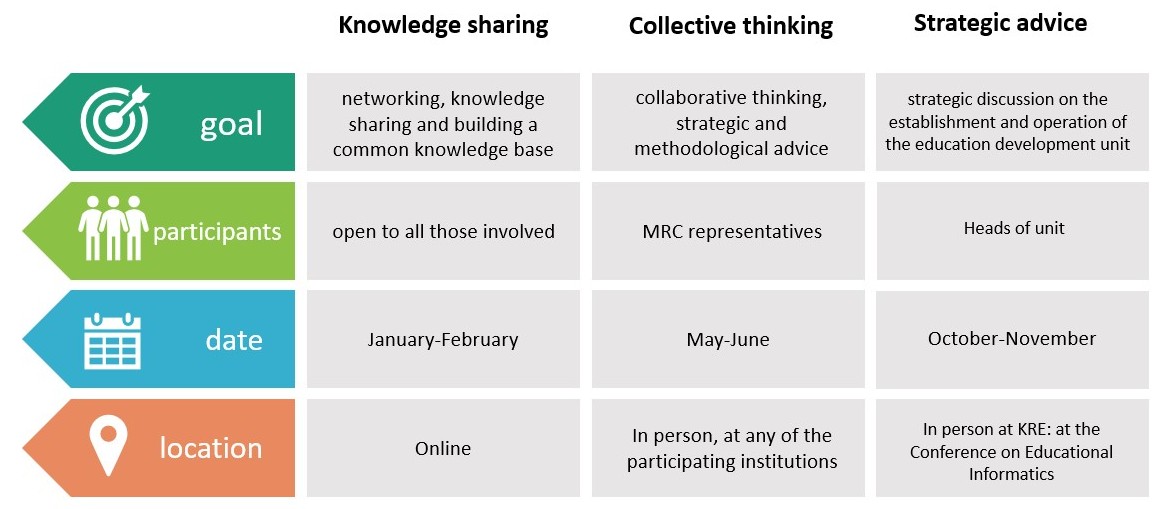
The forum organizes three meetings per year, at which professional consultations and roundtable discussions are held between participating institutions, focusing on the following areas:  


In the case of the first two events, the three institutions that had taken on the coordination of the cooperation from the outset and initiated the formation of the MRK working group served as hosts, with the active participation of the heads of their methodology and educational IT units: Corvinus University of Budapest (Dr. Kata Dósa), Budapest University of Economics (Dr. Adrienn Papp-Danka), and Károli Gáspár University of the Reformed Church (Dr. Ida Dringó-Horváth). According to the plan, the third, leadership and strategic meeting would be held on a permanent basis at the venue where the cooperation was formally initiated: KRE. Educational Technology in Higher Educationconferenceas part of an annual series of events (KRE ICT Research Center / KRE Education IT Training Center).   

During the formalization of the cooperation, it became apparent at the opening meeting that other institutions would also be happy to organize meetings, which the network's leadership fully supports in the spirit of democratic participation.  

The Hungarian Rectors' Conference (HRC)  is a body consisting of the heads of domestic higher education institutions. It represents and protects the interests of these institutions as an independent, consultative public corporation. The HRC comprises a plenary session, committees, and a presidency, with its work supported by the HRC Secretariat. Working groups, such as the HRC Forum, operate at the committee level but in a more flexible, project-oriented manner, shaping and discussing current issues in higher education. In addition to the methodological working group mentioned above, the two other currently active groups are the Digital Transformation Working Group, and the National Defense Education Working Group..